
Wilson
| Daily Dispatches Satellite phone updates from the 1998 American Everest Expedition CLICK FOR COMPLETE INDEX OF DISPATCHES |
|
Wilson |
 Wilson's view of a ladder crossing [click to zoom] (photo: Wilson) |
 |
4am. Time to go. Our race is against the dawn. As the Icefall heats up with the rising sun, the likelihood of a collapse increases. Our goal is to try and get through the Icefall before the sun hits the ice and weakens the bond of one block to another. The Icefall is a frozen river. Gravity drags the ice downward. The pull is constant. The slow, steady flow of ice is imperceptible, but not all of the Icefall's movements are slow, some are sudden. The sudden shifts are the ones to fear; they are the ones that will kill you.
|
 Eric Simonson climbs through ice debris [click to zoom] (photo: Wilson) |
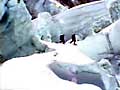
Our headlamps piercing the darkness, we follow a series of low angled snow ramps up into the maze of ice blocks, some the size of box cars. I watch Eric climbing above. He appears as just a dark shadow weaving in and out of the ice blocks and around the numerous crevasses.
Crevasses too wide to step across are bridged with aluminum ladders. Oftentimes two or three ladders are lashed together with rope. These sag and sway from body weight when crossed. It takes full concentration, confidence, and strong balance to make the crossing as the crampons scrape across the rungs of the ladder. Misstep, and it's headfirst into the cold, dark, seemingly bottomless pits below.
|
 Simonson under a huge serac [click to zoom] (photo: Wilson) |
| Streaming Video Through the Icefall | |
 | |
| (video: Burleson) REAL MEDIA modem speed (28k) (56k) (T1) RealPlayer |
|
| |
| NetShow modem speed (28k) (56k) (T1) NetShow |
The only line of defense is to move as rapidly as possible, but at 18,000' my lungs ache as they struggle to process the oxygen. My throat dries out quickly sucking in the bitter cold air, forcing me to cough, upsetting my body's pace and rhythm. My legs burn as I race the sun to the top of the Icefall. I want to go faster, knowing that every minute I spend in the maze of ice increases the odds of being buried in a collapse. My brain screams at my body to move faster, but I can't. The altitude severely limits my performance.
Exiting the corridor, Eric comes into view once again. The sun is lighting up the ridges of Everest and Nuptse high above. Our timing is perfect. We've won the race. Before the sun strikes we step out of the icefall and onto the broad, wide open, and gently rolling slopes leading to Camp I.
— Greg Wilson, Climber
| DISPATCHES | |
   |