| |
Summit Science
Measuring the world's biggest mountain
|
 |
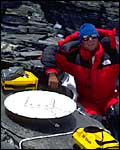
Wally Berg on the South Col (26,300') with GPS gear in '97
|
MORE ON SCIENCE
THE PLAN FOR '98
Expedition scientist, Dave Mencin, lays out what the '98 team will attempt to do on the summit.
BRAD WASHBURN INTERVIEW SERIES
Streaming video interview with legendary mountain geographer, Brad Washburn, who is behind the '98 project.
BRAD WASHBURN INTERVIEW 1997
Audio and transcript on the attempt to do summit science in 1997.
|
Science on Everest
Charles Corfield, Science Manager for the 1998 American Everest
Expedition, said the scientific work the climbers hope to accomplish on
or near the summit of Mount Everest is aimed at learning if the mountain
is moving, and where the actual bedrock ends and the snow begins.
To determine if tectonic motion is pushing the mountain up, down, sideways or not at all, the
climbers will attempt to fix a stainless steel plate to a large rock
just below the summit. The plate holds a threaded post on which a GPS
receiver and antenna can be mounted. When the Trimble 4800 GPS receiver
is switched on, it can establish the location of that rock within a few
millimeters. The challenge for the climbers is the time consuming work
of drilling holes in solid rock in the extreme conditions near the
summit.
On the summit itself, the climbers will attempt to locate where the snow
ends and the rock begins by using coring equipment to auger down through
the snow layers. It is hoped they can core deeply enough to strike
bedrock, but they concede that the rock may lie too deeply buried to be
found in this primitive manner. The drilling and coring will expose the
climbers to dangerous conditions of the summit for an extended period of
time, increasing the difficulty and danger of their summit day.


