|



|
 |
Grand Teton National Park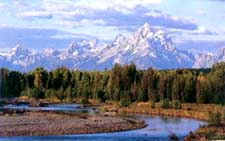
Towering more than a mile above the valley known as Jackson Hole, the Grand Teton rises to 13,770 feet above sea level. Twelve Teton peaks reach above 12,000 feet elevation, high enough to support a dozen mountain glaciers. In contrast to the abrupt eastern face, the west side of the range slopes gently,
showing the angle of tilt of the Earth's crust. Youngest of the mountains in the Rocky Mountain system, the Teton Range displays some of the North America's oldest rocks. The rise of the Teton Range as well as the erosion caused by eons of
glaciation have created the conditions that allow several plant communities to thrive, from ribbons of green riparian plants bordering rivers and streams, to sagebrush flats, lodgepole pine and spruce forests, subalpine meadows and alpine stone fields. The wide range of plant communities create habitat for a wide variety of animals, from the tiniest insects, to fish, birds and large and small mammals. Humans have taken advantage of the mountain setting and its abundant resources for approximately 11,000 years. Early residents occupied the valley during the short spring, summer and fall seasons. During the other eight
months of the year, they moved to lower elevations and warmer winter climates. Beginning in the late 1800's, homesteaders, ranchers and later dude ranchers moved into the valley, bringing the technologies of irrigation and insulation, to allow them to stay through the long, harsh winter. With the establishment of Grand Teton National Park in 1929, and later additions in 1950, culminating in today's park, a wide variety of resources are protected for future generations. Enjoy the natural and cultural resources of the park in safe, resource compatible ways, through the entire year.
|